
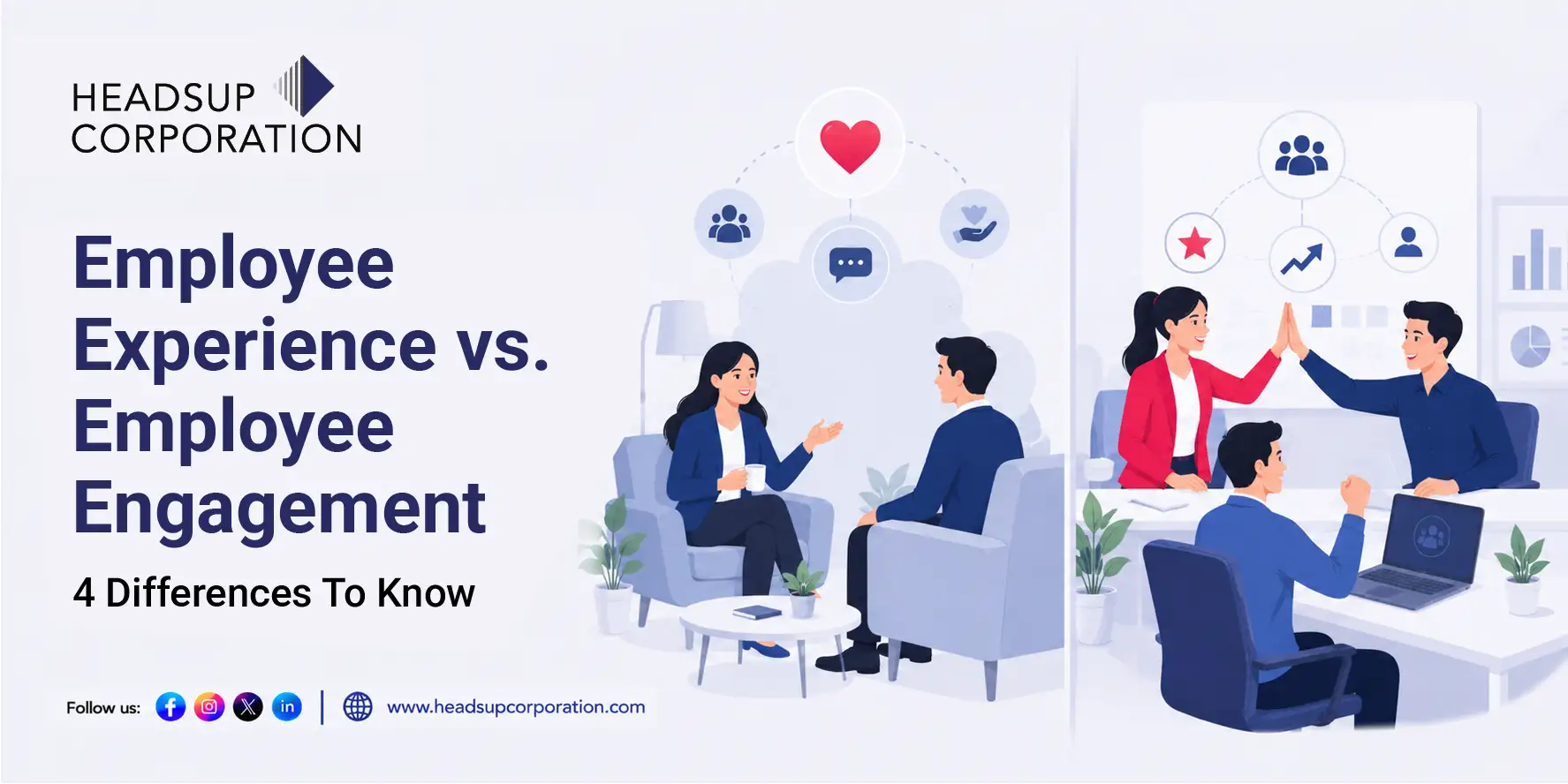
These two terms get used interchangeably constantly, and that’s a problem, because confusing them leads companies to spend money in the wrong place. Gallup’s 2026 State of the Global Workplace report found only 20% of employees worldwide feel engaged at work, an 11-year low, and a lot of companies respond by launching another engagement survey. That’s treating the symptom, not the cause.
What is employee experience?
Employee experience (EX) is the entire journey someone has with your organisation, the tools they use, the management quality they encounter, the physical or remote environment they work in, and every touchpoint from hiring through exit. It’s the input.
What is employee engagement?
Employee engagement is the psychological output of that experience: the emotional commitment, willingness to give discretionary effort, and active participation someone brings to their role and team. It’s the outcome. You can’t engineer engagement directly; you can only build the experience conditions that produce it.
4 key differences between employee engagement and employee experience
- Input vs. outcome. Experience is everything you provide; engagement is how people respond to it. You measure and act on experience; you mostly just observe engagement.
- Scope. Experience covers the entire employee lifecycle, onboarding, tools, management, career path, exit. Engagement is a narrower psychological state at a point in time.
- What drives each. Research shows 70% of team engagement is attributable to the quality of the manager alone, meaning engagement is often driven by a small number of experience factors, not a broad program.
- How you fix a problem in each. A bad employee experience (clunky tools, poor onboarding, unclear career paths) requires operational fixes. Low engagement scores require you to trace back to which specific experience factor is broken; engagement surveys alone rarely tell you which lever to pull.
Why the confusion actually costs companies money
Organisations spend an average of $2,400 per employee annually on engagement initiatives, yet 68% of HR leaders admit they can’t clearly define what engagement even means for their workforce. That’s money spent without a clear target. Meanwhile, the business case for getting this right is substantial; Gallup data shows engaged organisations see 59% less employee turnover and top-quartile business units show a 23% profitability difference and 18% productivity difference compared to bottom-quartile units.
How to measure employee experience and engagement
Measure experience through operational data, onboarding completion rates, internal mobility, manager quality scores, tool adoption, and exit interview themes. Measure engagement through pulse surveys, but pair every survey question with a specific experience factor it’s meant to diagnose, rather than asking generic “how engaged do you feel” questions that give you a score with no actionable lever attached.
How to improve employee experience and engagement
Start with the experience side, since that’s what you can actually act on directly. Fix manager quality first, given how much of engagement traces back to it; manager training and accountability usually deliver more than any standalone engagement campaign. Then tackle onboarding, career visibility, and recognition systems; fewer than 30% of companies currently rate their own recognition programs as highly effective, which is a fixable, concrete gap rather than an abstract culture problem.
How Headsup Corporation helps Indian companies close this gap
We help clients separate the two, building experience audits that actually trace back to specific engagement outcomes, rather than running another generic pulse survey. For Indian companies managing rapid hiring and hybrid teams, this usually means starting with manager capability and onboarding structure before touching recognition programs.
If your engagement scores keep dropping despite survey after survey, the issue is likely upstream in the employee experience. Headsup Coporation can help you trace it, get in touch to start with an experience audit.