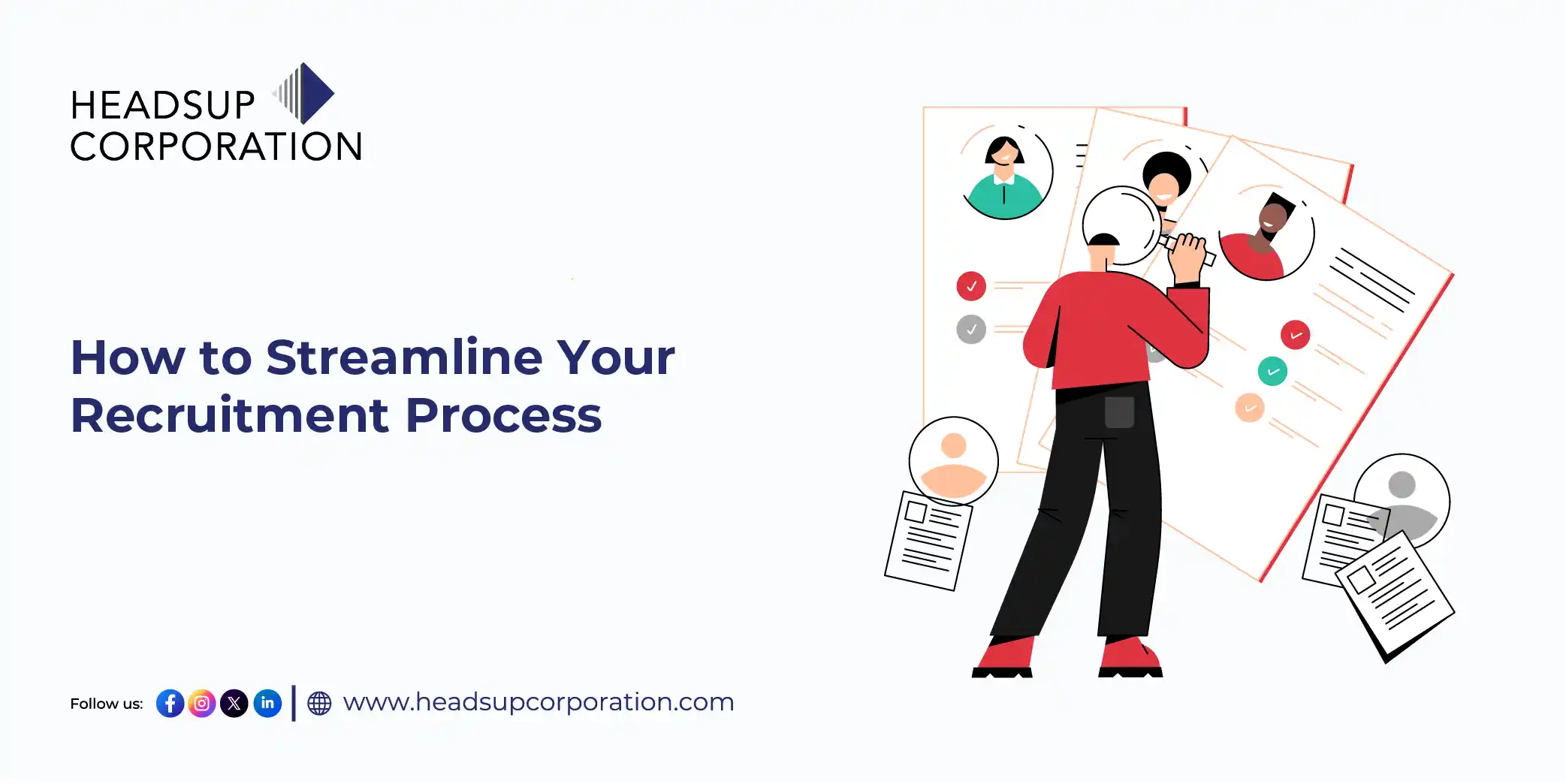
How to Streamline Your Recruitment Process: Turning Hiring into a Predictable, Efficient System
When a role opens, the requirement is discussed within teams, leadership and HR. Post when a job description is shared, applications begin to come in. And yet, somewhere along the way, momentum weakens. From feedback taking longer than expected, interview rounds stretch across weeks. Candidates who once seemed enthusiastic become harder to reach. Eventually, the position gets filled, but not without loss of time or productivity, but of talent.
This is not unusual; many organisations do not struggle because they lack access to capable candidates. They struggle because their recruitment process, as it currently exists, may not be designed for clarity, speed, or decision alignment. Streamlining recruitment, therefore, is not simply about hiring faster. It is about building a system where hiring decisions can happen with consistency, confidence, and minimal friction. Before exploring solutions, it may be worth pausing to reflect on how your current process operates.
Pause and Reflect: Where Does Your Hiring Process Actually Slow Down?
Let’s think about your most recent hire, not the outcome, but the whole journey. Did the role definition remain consistent from the beginning, or did expectations evolve midway? Were interview rounds conducted with clear intent, or did some conversations overlap in purpose? Did feedback move quickly, or did it require reminders and follow-ups? Did the candidate experience feel smooth and structured, or uncertain and prolonged?
Often, the answers to these questions reveal something important. Recruitment delays rarely occur because of a single large issue. They emerge from smaller inefficiencies that accumulate over time. A day’s delay in feedback here, an additional round of evaluation there, and suddenly, a process that was expected to take two weeks extends into two months. Recognising these friction points is the first step toward improving them.
Begin with Role Clarity, Not Just Role Documentation
Most recruitment processes begin with a job description. However, a job description alone does not always provide the clarity required for effective hiring. It describes responsibilities, qualifications, and expectations, but it may not fully capture the business intent behind the role. Streamlined recruitment begins when there is shared clarity around what success in the role actually looks like. When hiring managers and recruiters understand the outcomes the new hire is expected to deliver, evaluation becomes more focused. Conversations become more relevant. Decisions become easier to make.
You may find it useful to ask a simple question before hiring begins: What should this person be able to achieve within their first six months? The answer often brings alignment that a job description alone cannot provide. When role clarity exists early, recruitment moves forward with greater precision and fewer course corrections.
Design Interviews for Decision-Making, Not Just Evaluation
Interviews are intended to reduce uncertainty. However, when interview structures evolve without deliberate design, they may unintentionally increase it. Candidates may be evaluated repeatedly on similar dimensions, not because it is necessary, but because evaluation criteria were never clearly defined. This repetition slows the process and can create confusion among stakeholders. Interviewers may reach different conclusions, not because candidates are inconsistent, but because expectations are.
A streamlined recruitment process ensures that each interview serves a specific decision purpose. When conversations are structured with intent, each interaction contributes meaningfully to the final decision. This reduces redundancy, shortens timelines, and improves confidence in hiring outcomes. You might consider reflecting on your current process. Does each interview round answer a different question, or do some conversations simply revisit what has already been explored?
Introduce Defined Timelines to Maintain Momentum
Recruitment often slows down not because decisions are difficult, but because timelines remain undefined. When feedback is expected “when convenient,” it is naturally deprioritised in favour of immediate operational responsibilities. Over time, these small delays accumulate, and candidates wait longer than expected, resulting in momentum fading away.
Introducing defined timelines changes the rhythm of recruitment. When stakeholders understand when decisions are expected, hiring becomes a structured process rather than an open-ended activity. Candidates, too, respond differently when processes move with clarity. Timely communication signals organisational efficiency and seriousness. It reassures candidates that their time and effort are valued.
Create Visibility Across the Recruitment Journey
Recruitment involves multiple participants, each responsible for different stages. Without centralised visibility, information can become fragmented. Feedback may exist in isolated conversations, messages, or emails, making coordination slower and decisions harder to consolidate. When recruitment is managed through a unified tracking structure, visibility improves for everyone involved. Recruiters know where candidates stand. Hiring managers understand progress. Interviewers provide feedback within context. Decision-makers can move forward without unnecessary delays. This shift, from fragmented communication to centralised visibility, transforms recruitment from a reactive sequence of events into a coordinated process.
Consider the Candidate Experience as Part of Process Efficiency
Candidates experience recruitment differently from how organisations do. For them, each delay introduces uncertainty. Each unanswered message may influence perception. Each prolonged timeline may prompt them to consider alternative opportunities more seriously. When recruitment processes are structured, communication is timely, and expectations are clear, candidates remain engaged. They experience the organisation as decisive and professional. Streamlining recruitment, therefore, is not only about internal efficiency. It is also about strengthening external credibility.
When recruitment processes are streamlined, organisations do more than fill positions faster. They reduce productivity gaps, strengthen team stability and improve candidate quality by reducing drop-offs. They enable business continuity as well.
Perhaps most importantly, they remove uncertainty from a function that directly influences organisational performance. Recruitment, when structured effectively, becomes predictable, reliable and aligned with business timelines rather than working against them. In an environment where talent access influences growth directly, streamlining recruitment is no longer optional but essential.
How Headsup Helps Organisations?
Most organisations want to hire efficiently, but over time, processes evolve organically, and coordination becomes increasingly complex. What begins as a simple hiring workflow gradually becomes dependent on manual follow-ups and inconsistent evaluation methods.
Headsup helps organisations address this by introducing structure, clarity, and alignment across the recruitment lifecycle. This begins with understanding the role beyond its description and aligning stakeholders on evaluation priorities. When expectations are defined clearly at the outset, the hiring process becomes more focused, and decisions become easier to make. In addition, Headsup brings visibility and coordination into recruitment workflows. Candidate progress, stakeholder feedback, and hiring timelines are organized within a unified framework, ensuring that movement does not depend on individual availability alone. This reduces delays and helps organisations maintain consistent hiring momentum.