November 21, 2025 changed Indian employment law more decisively than any single date since Independence. On that day, the Ministry of Labour and Employment formally implemented the four new Labour Codes, consolidating 29 central laws into a unified framework covering wages, industrial relations, social security, and occupational safety.
Add to this the Digital Personal Data Protection Act 2023 and its 2025 rules, and the foundation under HR policies for companies in India has been entirely rewritten. Conversations across Reddit’s r/india and r/legaladviceindia in early 2026 reflect the panic on the ground; employees are asking why their basic pay suddenly jumped, founders are asking whether their appointment letters now expose them to litigation, and HR managers are asking what to update first. The answer is to start with a clear list of HR policies for companies in India that are now non-negotiable, and a second list of policies that, while not strictly mandatory, separate professional organisations from amateur ones.
Mandatory HR Policies for Companies in India Under the New Legal Framework
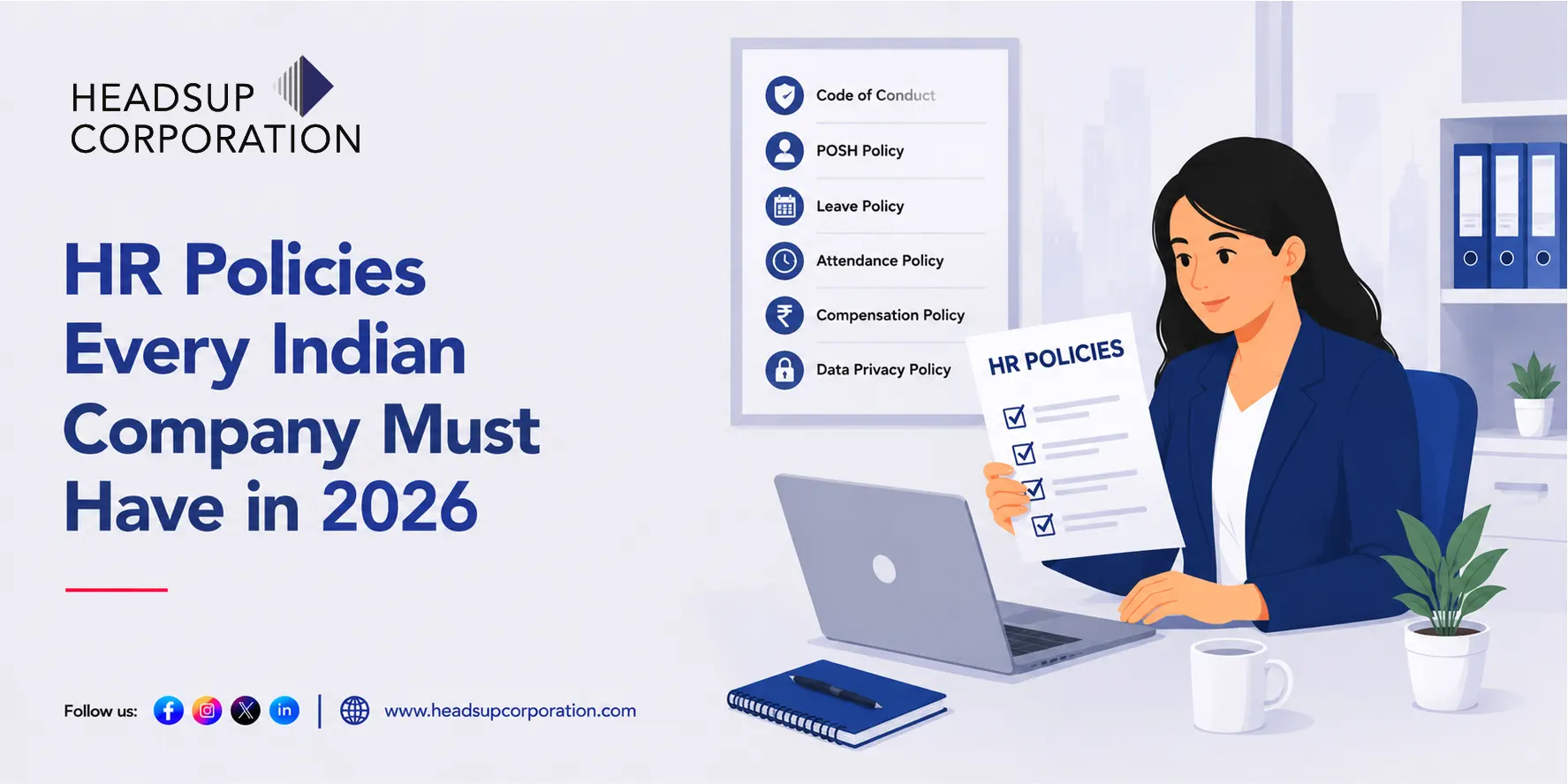
Several HR policies for companies in India are no longer optional, and missing any one of them creates direct legal exposure. A written employment contract or appointment letter is now mandatory for every new hire under the Industrial Relations Code, including fixed-term, contract, gig, and platform workers, and every inspection or dispute begins by asking for this document. A wages and salary policy must reflect the new Code on Wages, where basic salary cannot fall below 50% of total CTC, a structural change that directly affects PF, gratuity, and take-home calculations.
A statutory leave policy covering earned leave, sick leave, casual leave, public holidays, and maternity benefit under the relevant state Shops and Establishments Act is required for documentation during audits and exits. A POSH policy under the Sexual Harassment of Women at Workplace Act 2013 is mandatory for every workplace regardless of size, with companies employing 10 or more employees also required to constitute an Internal Complaints Committee. An equal opportunity policy is mandatory for organisations with 20 or more employees under the Rights of Persons with Disabilities Act 2016, covering non-discrimination across gender, religion, caste, and disability.
A maternity benefit policy guaranteeing 26 weeks of paid leave is required for organisations with 10 or more employees under the Maternity Benefit Act 2017. A data protection and privacy policy is now required under the DPDP Act 2023, with employers facing fines up to ₹250 crores for serious breaches of personal data, and HR is the custodian of nearly every category of regulated employee data.
Essential HR Policies for Companies in India That Build Operational Discipline
Beyond compliance, a second set of HR policy for companies in India separates professional employers from chaotic ones and protects the business when disputes arise.
A code of conduct defining behavioural expectations gives managers the documentation they need to enforce standards consistently. An attendance and working hours policy reflecting the new daily and weekly limits under the OSH Code prevents disputes over overtime liability.
A remote and hybrid work policy with clear anchor-day expectations has become the norm in 2026, replacing the post-pandemic free-for-all. An exit and offboarding policy outlining notice periods, full and final settlement timelines, and asset return prevents the kind of disputes that dominate Glassdoor and AmbitionBox reviews of Indian employers. A grievance redressal policy aligned with both the Industrial Relations Code and the DPDP Act creates a unified mechanism for handling wage complaints, behavioural complaints, and data correction requests.
How to Roll Out HR Policies for Companies in India Without Creating Resistance
Drafting a policy is the easy half; making employees acknowledge and follow it is the harder half. The discipline that distinguishes mature HR functions is to publish policies in an accessible HRMS or shared drive, secure signed acknowledgement from every employee, review every policy annually as laws and the business evolve, and enforce uniformly across levels because selective enforcement is what creates litigation risk. Make policies short, written in plain English, and translated where your workforce is multilingual.
How Headsup Helps Companies Build a Compliant HR Policy Framework
Headsup Corporation builds end-to-end HR policy frameworks for Indian companies that are aligned with the four new Labour Codes, the DPDP Act, and the realities of running a startup or large organisation in 2026. Our consultants audit your existing policies for gaps, draft state-specific documentation for multi-location teams, train your HR and line managers on rollout and enforcement, and provide ongoing updates as state-level Labour Code rules are notified. We work with founders who need a foundational policy stack and with established HR teams who need a compliance refresh, ensuring your policies protect the business and earn employee trust.
Need a complete, compliance-ready HR policy framework? Partner with Headsup Corporation for an end-to-end policy audit and rollout.