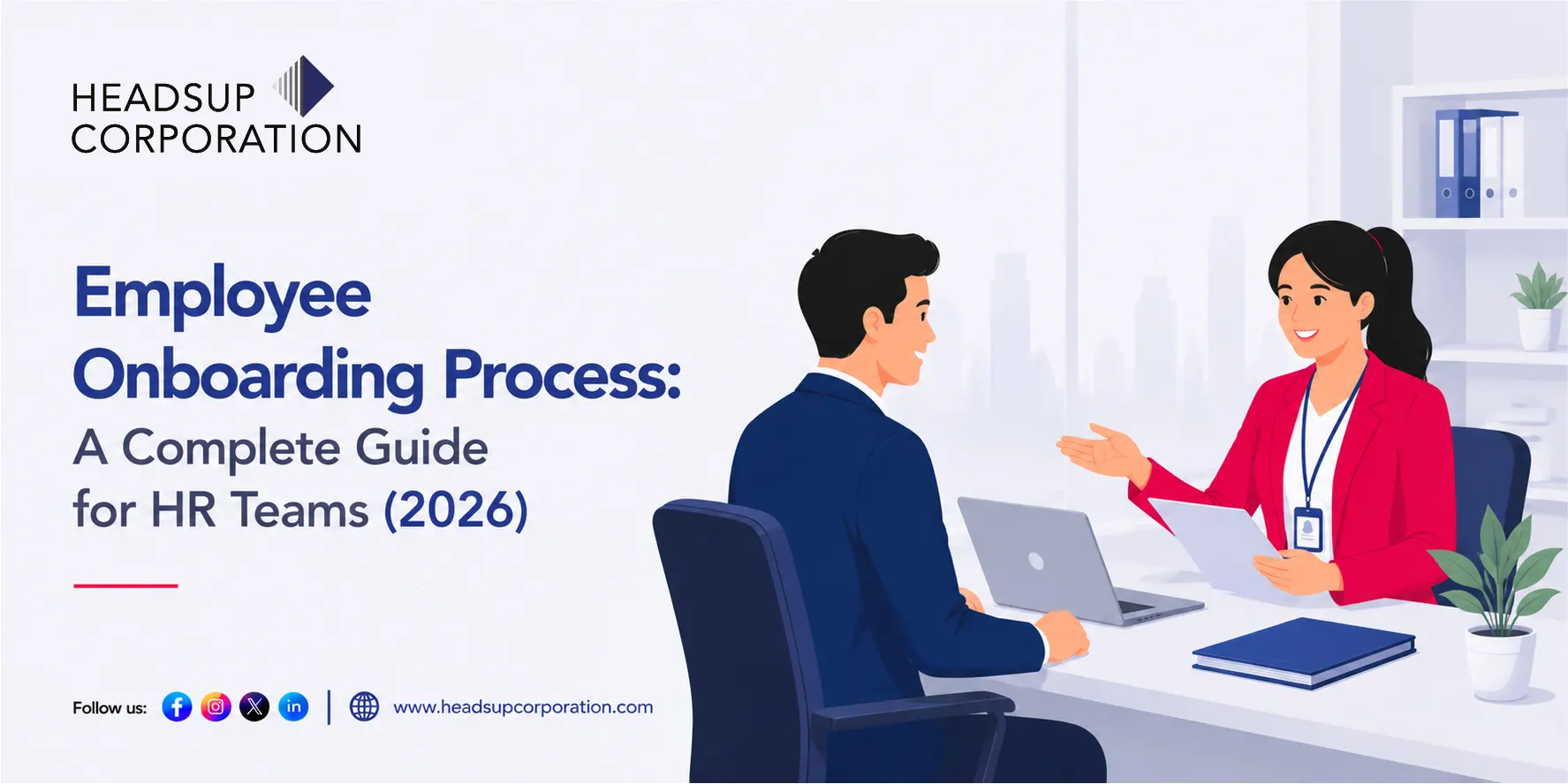
The first 90 days of an employee’s journey with your organisation are the most critical. Research consistently shows that employees who go through a structured onboarding process are significantly more likely to stay beyond their first year — and far more likely to reach full
productivity faster.
Yet most organisations treat onboarding as a formality. A stack of forms. A laptop setup. A quick office tour. And then — “good luck.”
In 2026, where talent is scarce and attrition is expensive, a poor onboarding experience is a business risk. The cost of replacing an employee who leaves within the first year can be as high as 50 to 200% of their annual salary. Most of that risk is preventable — with the right onboarding process.
This guide will walk you through everything you need to know to build an employee onboarding process that actually works — whether you are an HR professional at a growing company or a business owner onboarding your first few hires.
What is Employee Onboarding?
Employee onboarding is the process of integrating a new employee into your organisation — from the moment they accept their offer to the point where they are fully productive, confident, and connected to their team and culture.
It is important to distinguish onboarding from orientation. Orientation is a one-time event — usually the first day or week — where new hires complete paperwork and get a tour. Onboarding is a structured programme that typically spans 30 to 90 days, sometimes longer for senior roles.
Done well, onboarding helps new employees:
- Understand the organisation’s culture, values, and ways of working
- Get up to speed on their role and responsibilities faster
- Build relationships with their team and key stakeholders
- Feel confident, welcomed, and motivated to contribute
Why Onboarding Matters More Than Ever in 2026
The workplace has changed dramatically. Hybrid and remote work are now standard. New hires may never meet their manager in person in the first week. The informal connections that used to happen naturally in office corridors now have to be deliberately created.
At the same time, employee expectations have risen. New joiners in 2026 expect a seamless,
personalised, and well-organised onboarding experience — and they judge their employer by it.
The numbers tell the story:
- Organisations with a strong onboarding process see 82% improvement in new hire retention
- New employees who go through structured onboarding reach full productivity up to 70% faster
- 20% of employee turnover happens within the first 45 days — almost all of it preventable
👉 Related: 10 HR Planning Tips for Small Businesses and SMEs
The 7 Stages of an Effective Employee Onboarding Process
Stage 1: Pre-Onboarding (Before Day One)
Onboarding does not start on the first day — it starts the moment the offer is accepted.
The period between offer acceptance and the start date is a critical window. New hires are often still being approached by other employers, and second-guessing their decision. A thoughtful pre-onboarding experience reinforces their decision and builds excitement.
What to do in pre-onboarding:
- Send a warm welcome email or video from the hiring manager or team
- Share a clear first-day schedule so they know exactly what to expect
- Complete all paperwork digitally — contracts, tax forms, bank details — before day one
- Set up their laptop, email, and system access in advance
- Add them to relevant team communication channels
- Share useful reading — company handbook, culture deck, product overview
Action: Create a pre-onboarding checklist that HR triggers the moment an offer is accepted. The goal is that on day one, the new hire arrives feeling informed and excited — not anxious and confused.
Stage 2: Day One — First Impressions
The first day sets the tone for everything that follows. It should feel organised, welcoming, and human.
What a great Day One looks like:
- A personal welcome from their direct manager — not just HR
- A team introduction — not a formal presentation, but a genuine warm welcome
- A clear agenda for the day so they are never wondering “what am I supposed to be doing?”
- Working equipment ready and set up — nothing damages first impressions faster than a laptop that is not set up
- A buddy or onboarding partner assigned to help them navigate informally
- A lunch or coffee with their immediate team
What to avoid on Day One:
- Drowning them in information — keep it digestible
- Leaving them alone for long stretches
- Making them sit through hours of back-to-back presentations
- Paperwork that should have been done in pre-onboarding
Stage 3: First Week — Culture and Context
The first week is about helping the new hire understand the organisation — its culture, its people, and how things work.
Focus areas for the first week:
- Company history, mission, values, and strategic direction
- Introduction to key stakeholders across departments
- Overview of tools, systems, and processes they will use
- Understanding of their team’s goals and how their role contributes
- Initial conversations about their 30-60-90 day plan
For HR teams: Create a structured first-week schedule that balances information with time to absorb and connect. Mix formal sessions with informal conversations.
For business owners: Even in a team of 10 people, a structured first week makes a huge difference. Block time in your calendar to personally spend time with every new joiner in their first week.
👉 Related: 7 Steps of Human Resource Planning Process in HRM
Stage 4: First 30 Days — Role Clarity and Early Wins
By the end of the first month, a new employee should have a clear understanding of their role, their team, and what success looks like. They should also have had the opportunity to contribute — even in a small way.
Focus areas for the first 30 days:
- Deep dive into their specific role and responsibilities
- Understanding of key processes, workflows, and tools relevant to their work
- First one-on-one meeting with their manager — and regular check-ins established
- Identification of a quick win or early contribution opportunity
- Feedback on initial performance and adjustment of expectations if needed
The 30-day check-in: Schedule a formal 30-day check-in between the new hire and their manager. Ask: How are you settling in? What is going well? What is confusing or unclear? What do you need more support with?
Stage 5: 30 to 60 Days — Building Confidence
By the second month, the new hire should be moving from learning mode to contributing mode. They should be building relationships, taking on real work, and starting to operate with some independence.
Focus areas for 30 to 60 days:
- Taking ownership of specific projects or responsibilities
- Deeper relationship building with cross-functional teams
- Feedback from peers and stakeholders on their integration
- Identification of any skill gaps and creation of a development plan
- Regular one-on-ones with their manager — at least fortnightly
Watch for: Signs of disengagement, confusion, or frustration in this period. If a new hire is
struggling at the 45-day mark, early intervention is significantly more effective than waiting
until the 90-day review.
👉 Related: How to Improve Employee Engagement in 2026
Stage 6: 60 to 90 Days — Full Contribution
By the end of 90 days, a well-onboarded employee should be operating at close to full productivity. They should feel genuinely part of the team, clear on their priorities, and confident in their ability to contribute.
Focus areas for 60 to 90 days:
- Full ownership of their role and responsibilities
- Setting of formal performance goals aligned to team and company objectives
- Feedback conversation — honest assessment of performance and integration
- Discussion of career development and growth opportunities
- Transition from structured onboarding to regular performance management
The 90-day review: This is a milestone conversation — not a performance appraisal. It should
cover: How has the experience been? What have you learned? What are your goals for the next
quarter? What support do you need to succeed?
Stage 7: Beyond 90 Days — Long-Term Integration
Onboarding does not end at 90 days — especially for senior or specialist hires. True integration — where an employee is fully embedded in the culture and operating at their best — often takes 6 to 12 months.
What long-term integration looks like:
- Regular one-on-ones with their manager
- Ongoing learning and development opportunities
- Inclusion in strategic conversations relevant to their role
- Regular feedback — both giving and receiving
- Stay interviews to understand what keeps them engaged
👉 Related: How Succession Planning Can Help Your Firm
Employee Onboarding Checklist
Pre-Onboarding
- Offer letter and contract sent and signed
- Welcome email sent with first-day details
- Laptop and equipment ordered and set up
- Email and system access created
- Added to team communication channels
- Buddy/onboarding partner assigned
- First-day schedule shared
Day One
- Personal welcome from manager
- Team introduction organised
- Office/workspace tour (in-person or virtual)
- IT setup verified and working
- Company handbook shared
- First-day agenda provided
First Week
- Company culture and values session
- Key stakeholder introductions
- Tools and systems overview
- Team goals and role context discussion
- 30-60-90 day plan drafted
First 30 Days
- 30-day check-in meeting scheduled
- First one-on-one with manager completed
- Role and responsibilities clearly defined
- Quick win opportunity identified
- Feedback shared
60-90 Days
- 90-day review scheduled
- Performance goals set
- Development plan created
- Career growth conversation initiated
Common Onboarding Mistakes to Avoid
Starting too late — Onboarding that begins on day one misses the critical pre-onboarding window. Start the moment the offer is accepted.
Information overload — Sharing everything in the first week overwhelms new hires and ensures most of it is forgotten. Space information delivery over the full 30 to 90 days.
No manager involvement — When onboarding is handled entirely by HR, new hires miss the relationship with their direct manager that matters most. Managers must be active participants.
No feedback loop — Onboarding without check-ins and honest feedback leaves issues unaddressed until it is too late. Build regular touchpoints into the process.
One size fits all — A graduate joiner and a senior hire need very different onboarding experiences. Tailor your process to the role and level.
Treating onboarding as admin — Onboarding is a strategic retention and performance tool.
Treat it that way.
Onboarding for Remote and Hybrid Teams
Remote and hybrid onboarding requires extra intentionality. The informal connections that happen naturally in an office need to be deliberately created.
What works for remote onboarding:
- Video calls over messaging for all early interactions — face-to-face connection matters
- A virtual buddy who checks in daily in the first two weeks
- Clear documentation of processes and ways of working — remote employees cannot ask a colleague sitting next to them
- Virtual coffee chats with team members — scheduled, not optional
- Regular video check-ins with the manager — at least twice a week in the first month
👉 Related: 5 Tips to Nail Your Virtual Onboarding Process
How Headsup Corporation Helps
Headsup Corporation’s People Advisory Services team helps organisations design and implement structured onboarding programmes that reduce early attrition, accelerate time-to productivity, and create a lasting first impression.
From onboarding roadmap design to manager training and new joiner experience audits — we help businesses build onboarding processes that work at every stage of growth.
👉Talk to our People Advisory team today
Also read: