What L&D Consultancies Do and How to Pick One
Many Indian companies do not have a training problem. They have a capability problem. Sales teams know the product but struggle to close. First-time managers are promoted for their technical skills and then left to figure out people management on their own. Training budgets get spent, attendance sheets get signed, and six months later, little has changed.
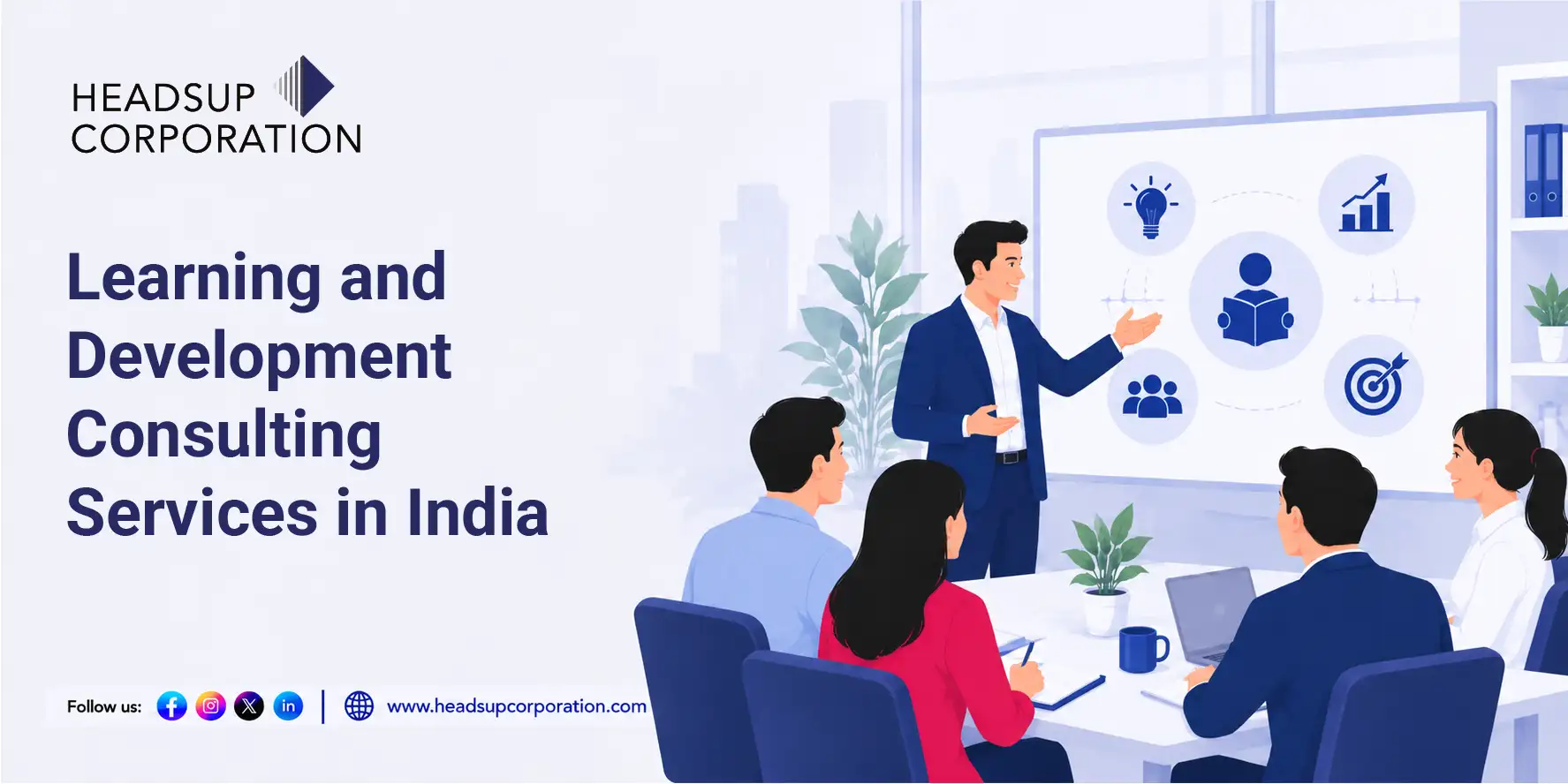
This is the gap learning and development consulting is designed to close. A good L&D consultancy does not just run workshops. It helps you work out which skills move business results, designs learning around those skills, and measures whether behaviour on the job changes.
This guide explains what learning and development consulting services include, how an L&D consultancy differs from an individual consultant or your in-house team, when it makes sense to bring one in, and how to choose the right partner in India.
What Is Learning and Development Consulting?
Learning and development consulting is the practice of helping organisations plan, build and measure employee learning so that it supports business goals. Instead of starting with a catalogue of courses, an L&D consulting partner starts with questions like: Which roles are critical to our growth plan? What skill gaps are slowing those roles down? What would better performance look like on the job?
The work typically sits at the intersection of HR, business leadership and line management. If you want a refresher on how L&D fits within the wider HR function, read our guide on learning and development in HRM.
What Do L&D Consulting Firms Actually Do?
Scope varies from firm to firm, but most learning and development consulting services fall into five areas.
1. Training needs analysis (TNA)
This is the diagnostic stage. Consultants review role expectations, performance data, manager inputs and business plans to find the gaps that matter most. A strong TNA separates skill gaps (people do not know how) from system gaps (unclear processes, wrong incentives, poor tools), because training cannot fix the second kind.
2. Learning strategy and roadmap
Based on the diagnosis, the consultancy builds a 12 to 24 month learning roadmap: priority audiences, capability areas, formats, budget split and success measures. For a growing Indian company, this often means sequencing priorities, for example manager capability first, then sales enablement, then a structured onboarding curriculum for campus hires.
3. Programme design and delivery
This covers the actual learning journeys: leadership and manager development, functional and technical training, behavioural skills, and statutory programmes such as POSH awareness sessions that Indian employers are required to run (see why your company needs to be POSH compliant). Good firms blend formats: classroom or virtual sessions, on-the-job assignments, coaching, peer learning and short digital modules that suit hybrid and multi-city teams.
4. Learning technology and content
Many L&D consulting companies help select or set up a learning management system (LMS), build a content library, and decide what to buy off the shelf versus build in-house. Microlearning and on-demand formats are especially useful for frontline and field teams; we cover this in how microlearning and on-demand training are changing employee development.
5. Measurement and impact
This is where most training efforts fall short. A capable consultancy defines upfront what success looks like, such as time to productivity for new hires, manager effectiveness scores, sales conversion or quality metrics, and tracks those, not just attendance and feedback forms.
L&D Consultant vs L&D Consulting Firm vs In-House Team
Companies often ask whether they need a firm at all, or whether an individual consultant or their own HR team can handle it. The answer depends on scale and complexity.
| Option | Best suited for | Watch out for |
| Independent L&D consultant | A single, well-defined need such as one leadership programme or a TNA for one function | Limited bandwidth; harder to scale across locations or run several programmes at once |
| L&D consulting firm | Company-wide strategy, multiple audiences, multi-city delivery, measurement frameworks | Generic, off-the-shelf content sold as ‘custom’; check for real diagnostic depth |
| In-house L&D team | Ongoing delivery, culture-specific programmes, continuity | Can get stuck in delivery mode with little time for strategy or impact measurement |
| Hybrid model | Mid-sized companies wanting external strategy with internal continuity | Needs clear role split and a handover plan |
Many mid-sized companies use a hybrid model: an external consultancy designs the strategy and flagship programmes, and the in-house team runs and sustains them. For a closer look at the individual consultant role, see our article on what a learning and development consultant does.
When Does Your Company Need L&D Consulting Services?
You do not need an L&D consultancy just because you have a training budget. These are the signs it is time to bring one in:
- Training spend is rising but results are not. Programmes get good feedback scores, but managers see no change in how people work.
- You are scaling fast. Headcount is growing across cities, and onboarding and manager quality are slipping.
- First-time managers are struggling. Attrition or disengagement is concentrated under specific managers.
- A business shift needs new skills. New markets, a new product line, automation or AI adoption that changes how roles work.
- HR is stretched. Your HR team handles hiring, payroll and compliance, and L&D always comes last.
- Leadership wants proof of ROI. The CFO or founder is asking what the learning budget is delivering.
If several of these apply, the issue is usually strategic, not tactical, and that is where external consulting adds the most value. Our post on why you might be doing L&D wrong covers some of these patterns in more detail.
How to Choose the Right L&D Consultancy in India
Learning and development consulting firms in India range from global firms to boutique specialists and independent trainers who brand themselves as consultancies. Use this checklist to compare options:
Start with diagnosis, not a course list
Ask how they will understand your problem before proposing a solution. A firm that sends a programme brochure in the first meeting is selling content, not consulting.
Check relevant experience
Look for experience with companies of your size, sector and workforce type. Designing learning for a 50-person startup is very different from building a programme for a 5,000-person manufacturing workforce spread across plants.
Ask how they measure impact
Request a sample measurement plan from a past engagement. You want to see business and behaviour metrics, not just ‘participants rated the session 4.5/5’.
Look at customisation and language
India’s workforce is diverse. Can they adapt content for regional languages, frontline staff, or hybrid teams? Are case studies and examples relevant to Indian workplaces rather than borrowed from Western contexts?
Understand who will do the work
Meet the consultants and facilitators who will run your engagement, not just the partner who pitches it.
Clarify ownership and handover
Who owns the content and frameworks at the end? Will your team be trained to run programmes independently? A good partner builds your internal capability instead of creating dependence.
Red flags to watch for: guaranteed results without a diagnosis, no references you can call, one-size-fits-all programmes, and no clear plan for follow-up after training days end.
Common Engagement Models
Most L&D consulting companies work in one of three ways, and many clients combine them over time:
- Project-based: a fixed scope such as a TNA, a learning strategy or the design of one programme. Good for a first engagement.
- Programme-based: design and delivery of a specific journey (for example, a six-month first-time manager programme), usually priced per cohort or per participant.
- Retainer or embedded model: an ongoing partnership where the consultancy acts as an extension of your L&D function, useful when you do not have a dedicated L&D head.
Pricing depends heavily on scope, customisation, delivery format and the number of locations, so ask for itemised proposals that separate diagnosis, design, delivery and measurement. This makes it easier to compare firms on a like-for-like basis.
Mistakes to Avoid When Working with an L&D Consultancy
- Skipping the needs analysis to save time. It is the cheapest phase and has the biggest effect on whether the rest works.
- Leaving managers out. Learning sticks only when managers reinforce it on the job. Involve them in design and follow-up.
- Treating training as a one-time event. Behaviour change needs practice, reminders and reinforcement over weeks, not one workshop.
- Disconnecting L&D from talent decisions. Learning works best when it connects to performance reviews, career paths and succession plans. Our guide to building a talent management strategy explains how these pieces fit together.
Key Takeaways
The right L&D partner starts with diagnosis, not a course catalogue. Look for a firm that links learning to business outcomes, involves your managers, and builds your team’s capability rather than dependence. Start small with a diagnostic, measure what changes on the job, and scale from there.
How Headsup Corporation Helps
At Headsup Corporation, we treat learning and development as part of a wider talent picture, not as a standalone training calendar. Through our Talent Management & Growth Analysis services, we help organisations identify critical capability gaps, design development plans for high-potential employees and managers, and connect learning to performance, retention and succession.
Whether you are a startup building your first manager programme or an established company rethinking L&D after rapid growth, a structured diagnostic is the right place to start. Book a consultation with our team